
Find out how RCS messaging is changing brand communications providing rich, interactive capabilities. Find out why companies in India are using RCS to enhance customer interaction, better plus sort out their workflow, and offer app-like functionality in the native inbox.
The New Era of Messaging: Richer, Faster, Smarter
RCS messaging for brands is changing how businesses communicate with customers by combining the reliability of SMS with the rich, interactive experience of a mobile app.
SMS has long been one of the most dependable communication channels for brands because it is fast, accessible, and universally familiar. It still plays a critical role in applications such as OTP authentication, transactional alerts, and service notifications.
But customer expectations have evolved.
Today’s users expect messaging experiences that are visual, interactive, and actionable — not just plain text notifications. According to Juniper Research, RCS open rates average 70–80%, compared to around 20% for email. For India, where over 500 million smartphones run Android, this makes RCS one of the biggest messaging upgrades since SMS itself.
Think of it this way: RCS is SMS getting an upgrade.

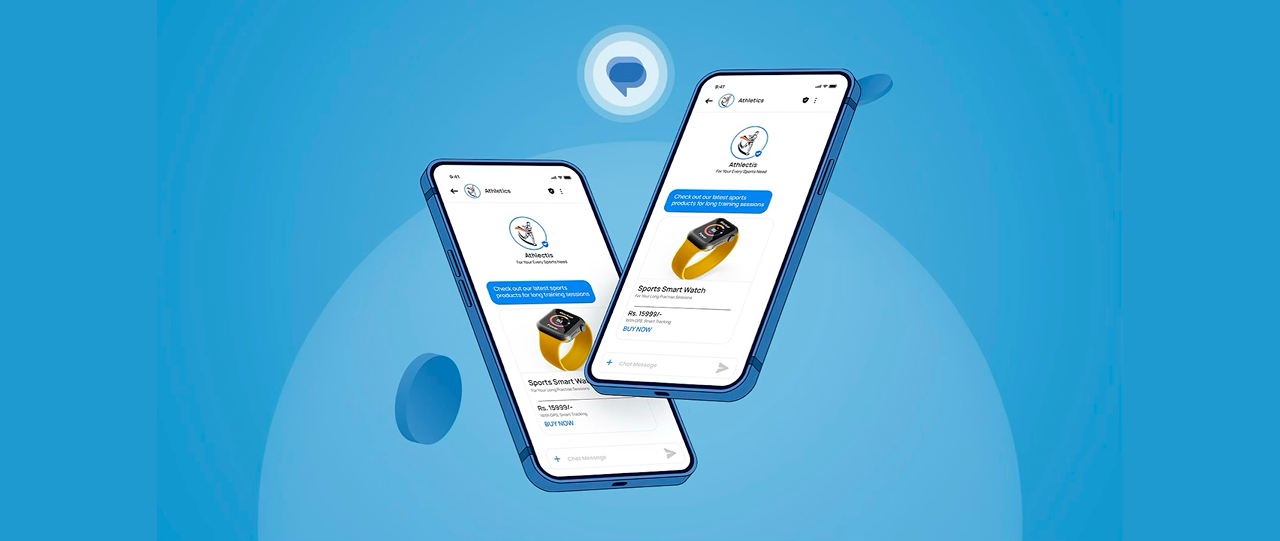
Rich Communication Services (RCS) builds on the strengths of traditional text messaging while adding features such as high-resolution images, branded sender profiles, carousels, clickable buttons, read receipts, and real-time interaction — all within the phone’s native messaging app.
Instead of replacing SMS, RCS expands what messaging can do for customer engagement.
What is RCS Messaging?
RCS — Rich Communication Services — is the next-generation standard for business text messaging, replacing basic SMS with interactive, media-rich messages delivered directly inside a customer’s native messaging app.
Think of traditional SMS like sending a postcard.
Now imagine replacing that postcard with a glossy, interactive magazine that includes images, buttons, maps, videos, carousels, and live updates — all inside the same inbox customers already use every day.
That is what RCS does.
Unlike many messaging platforms, RCS does not require customers to download another app or create a separate account. If a smartphone supports RCS, the experience works directly inside the default messaging application.
RCS messaging supports features such as:
- High-resolution images and videos
- RCS interactive buttons
- Product carousels
- Suggested replies
- Verified sender profiles
- Read receipts
- Real-time delivery tracking
- Maps and location sharing
With iOS 18 (2024) bringing RCS support to Apple devices for the first time, RCS now reaches both Android and iPhone users — covering over 85% of smartphones globally.
This is what makes Rich Communication Services one of the most important upgrades in modern business messaging.
RCS vs SMS vs WhatsApp: What’s the Difference?
SMS is plain-text messaging with universal reach. WhatsApp requires a separate app and internet connection. RCS messaging combines the reliability of SMS with the interactivity of WhatsApp — while working natively inside the device’s messaging app.
| Feature | SMS | RCS Business Messaging | |
|---|---|---|---|
| Message format | Plain text only | Text, images, video, buttons | Text, images, video, carousels, buttons, maps |
| App required | No — native | Yes — WhatsApp app | No — native messaging app |
| Delivery without internet | Yes | No | No (data required) |
| Verified brand sender | No | Yes (Green Tick) | Yes (verified brand profile) |
| Read receipts | No | Yes | Yes |
| Interactive buttons | No | Yes | Yes |
| Fallback if unsupported | N/A | N/A | Falls back to SMS automatically |
| iOS support | Yes | Yes | Yes (from iOS 18 / 2024) |
| India DLT registration required | Yes | No | Yes (via TRAI DLT platform) |
This is why many businesses now see RCS as the bridge between basic SMS alerts and fully conversational messaging platforms.
Why RCS Messaging Matters for Brands Right Now
RCS matters because it combines the open-rate reliability of SMS with the interactivity of a mobile app — helping brands drive action, improve engagement, and measure performance directly inside the customer’s messaging inbox.
Traditional SMS still works extremely well for alerts, OTPs, and transactional communication.
But it has limitations.
Plain text messages cannot fully support modern customer engagement journeys where users expect richer, more guided experiences.
RCS changes that.
Instead of sending a static message, brands can create interactive experiences directly within the inbox. A retailer can showcase products in a swipeable carousel with “Shop Now” buttons. A bank can send a verified payment reminder with a one-tap “Pay EMI” CTA. A travel brand can send check-in details alongside boarding information and location maps.
This transforms messaging from a one-way notification channel into a two-way customer interaction experience.
Unlike traditional messaging, RCS also provides visibility into customer engagement. Brands can track opens, clicks, read receipts, and interactions in real time — helping teams improve campaign performance continuously.
AI-powered personalisation makes RCS campaigns even smarter. Businesses can combine RCS messaging with conversational AI and customer behavior insights to deliver more relevant communication at scale. Learn more in our guide on AI in CPaaS.
In India, the case for RCS is especially strong. In December 2025, Bharti Airtel partnered with Google to roll out RCS Business Messaging across Indian enterprises — the largest carrier-backed RCS rollout in the country. With over 500 million Android users and Android market share above 90%, India is one of the most RCS-ready markets in the world.
RCS Messaging in Action: Industry Examples from India & the Middle East
Businesses across India and the Middle East are already using RCS messaging to improve customer communication, reduce friction, and increase engagement.
Here is what RCS looks like across different industries.
| Industry | What RCS Enables | India / Middle East Example |
|---|---|---|
| Banking & Finance | Branded payment alerts with “Pay Now” buttons, verified OTP messages, fraud alerts with action options | Indian private banks sending TRAI-compliant RCS payment reminders; UAE banks using verified RCS OTP flows with one-tap “Block Card” actions and escalation to Smart IVR |
| E-Commerce & Retail | Product carousels, flash sale campaigns, “Shop Now” buttons, order tracking with live delivery updates | Indian D2C brands using RCS carousels for WhatsApp-level engagement without Meta conversation fees; GCC e-commerce brands using RCS for COD confirmations and delivery map links |
| Health and Wellness | Appointment reminders with “Confirm / Reschedule” buttons, medication reminders, follow-up instructions | Indian hospital chains replacing missed-appointment SMS flows with interactive RCS reminders; Middle East clinics using multilingual RCS patient communication |
| Logistics and Transportation & Travel | Real-time parcel tracking, delay alerts, boarding pass carousels, itinerary updates | Indian courier companies using RCS for last-mile delivery updates; GCC airlines using interactive itinerary updates and check-in reminders |
These examples show how RCS fits naturally into existing customer journeys while making communication more useful, visual, and action-oriented.
How OneXtel Delivers RCS Messaging for Your Business
OneXtel makes RCS adoption simple — integrating into your existing systems, managing TRAI DLT registration for India, enabling automatic fallback to SMS, and helping businesses launch verified sender messaging with minimal operational complexity.
RCS does not require businesses to completely rebuild their communication workflows.
With the right CPaaS partner, RCS can integrate into your existing CRM, campaign management tools, customer support systems, and automation workflows.
OneXtel helps businesses:
- Launch verified RCS messaging campaigns
- Enable automatic SMS fallback for unsupported devices
- Manage verified sender registration
- Track engagement through real-time analytics
- Integrate RCS into existing customer engagement workflows
For businesses operating in India, OneXtel also handles TRAI DLT sender registration, which is mandatory for business messaging compliance under Indian telecom regulations.
This helps brands stay compliant while delivering trusted, branded business messaging experiences at scale.
What RCS Looks Like in Practice: A Real Business Scenario
Here is what an RCS campaign looks like in practice — using a retail flash sale as the example.
Imagine a fashion retailer launching a limited-time festive sale.
Instead of sending a plain text SMS saying:
“50% OFF today only.”
The retailer sends an RCS message featuring:
- A high-resolution product carousel
- Product images and pricing
- Swipeable categories
- “Shop Now” buttons
- Store location maps
- Real-time delivery tracking
Customers can browse products, tap to purchase, and track orders directly inside the message thread.
No app switching.
No extra steps.
No friction.
For a bank, this could look like a verified fraud alert with a one-tap “Block Card” button.
For a clinic, it could be an appointment reminder with “Confirm” or “Reschedule” options.
For a travel brand, it could be an interactive boarding pass with gate updates and check-in reminders.
For a food delivery company, it could be live order tracking with delivery ETA updates.
This is why CPaaS customer retention strategies increasingly rely on rich, interactive messaging experiences like RCS.
Why Starting With RCS Now Gives You a Competitive Edge
Brands that adopt RCS now will have months or years of optimisation data, verified sender trust, and customer familiarity before competitors catch up — creating the same first-mover advantage that early adopters of email marketing and social media advertising once enjoyed.
Most customers are still unfamiliar with branded RCS experiences.
That novelty creates opportunity.
Early adopters benefit from:
- Higher engagement rates
- Lower inbox fatigue
- Better brand recall
- Stronger trust through verified sender profiles
- Higher interaction rates than traditional SMS campaigns
This matters especially in markets like India and the Middle East, where mobile-first customer behavior dominates.
As inboxes become more crowded over time, early RCS adoption gives brands valuable learning advantages before the channel becomes saturated.
For businesses planning a long-term SMS to RCS upgrade, this is the ideal moment to experiment, optimize, and build customer familiarity early.
Frequently Asked Questions
RCS messaging stands for Rich Communication Services. It is the next generation of business messaging that upgrades traditional SMS with images, buttons, carousels, branding, and interactive experiences delivered directly inside the phone’s native messaging app — without requiring a separate download.
SMS supports plain-text communication only. RCS messaging adds images, carousels, interactive buttons, verified sender branding, read receipts, and richer customer experiences. If a device does not support RCS, messages can automatically fall back to SMS.
Both channels have strengths. WhatsApp offers a strong conversational ecosystem, while RCS works natively inside the customer’s default messaging app without requiring a separate platform. For businesses in India, RCS can reach over 90% of Android devices without Meta’s per-conversation messaging fees.
Yes. India is one of the most RCS-ready markets globally because of its large Android user base. Airtel partnered with Google in December 2025 to accelerate enterprise RCS rollout, and businesses sending RCS campaigns must complete TRAI DLT registration compliance.
Yes. Apple introduced RCS support with iOS 18 in 2024. Both Android and iPhone users can now receive RCS messages natively through their device messaging applications.
The easiest way is to work with a verified RCS provider who handles sender registration, TRAI DLT compliance, verified sender setup, and automatic SMS fallback. OneXtel manages the complete process — from setup to campaign launch.